Teleporter

Hey Visitor,

I'm a bunny and my name is Sooki, I'm hired by the contributors to operate this teleport service!

If you want, you can quickly teleport to the next destinations (best of all it's FREE!):

  • Goonzu
  • Showing posts with label Facts. Show all posts
    Showing posts with label Facts. Show all posts

    Saturday, August 14, 2010

    5 sundays in august 2010 only happening every 823 years!


    This month there's been a message circulating by sms, email, facebook, ... all over the world which said something about August 2010 as having "...5 Sundays, 5 Mondays and 5 Tuesdays" and that "this won't happen again in another 823 years".

    However in 2010 alone there are three other 5-day combinations in a month. These are:
    • May 2010 with 5 Saturdays, 5 Sundays and 5 Mondays

    • July 2010 with 5 Thursdays, 5 Fridays and 5 Saturdays, and

    • December with 5 Wednesdays, 5 Thursdays and 5 Fridays


    While looking for more information on this supposed phenomenon, I came upon entries about August 2009, which, on the other hand, had 5 Saturdays, 5 Sundays and 5 Mondays just like what May 2010 had I also came across a post about Five sundays in august 2010 and other (of which this post has content).
    It's not a unique thing as it happened in: August 1999, 2010, 2021, 2032 all have 5 Sundays, 5 Mondays and 5 tuesdays.. So as you can see it repeats every 11 years..
    All 31 day months have three consecutive days that occur five times. With only seven possible starting points, it happens way more often than every 823 years.
    EVERY single month with 31 days gets a sequence of three consecutive days repeated five times. It can't be ANY other way.

    In other words, this happens 7 times a year, since there are 7 months with 31 days.

    How could anyone believe that this happens only once every 800 years?

    You don't need any math to figure this out. It happens every time that August starts on a Sunday. And that, of course, happens once every seven years, on average.

    It actually happens every 6, 11, 6, 5 years:

    August 1976, 1982, 1993, 1999, 2004, 2010, 2021, 2027, 2032 all have 5 Sundays, 5 Mondays, and 5 Tuesdays.

    In fact if it's not August specific the next occurence then it next happens in May 2011.
    The next time we get five Sundays, Mondays and Tuesdays in August will be August 2021. These are things you can look up for yourselves, so there's no need to believe everything you get in your email inbox.

    So how did this start out?
    Apparently this all started because a person on Twitter wanted to start a "mystical rumor".

    Well now you know!

    Thanks to:

    Monday, May 31, 2010

    Goodgame Farmer Review


    Goodgame Farmer is a farm game similar to farmville, but still in beta. Since it's still in beta, there are a lot of improvements to be done.


    Bugs:


    • disappearing persona (tileeventup event bug)

    • can’t modify field when persona is on field other than yourself

    • can’t modify field even if no persona is on field, others most often can.

    • clicking on friend popup display goes away sometimes

    • clicking on field while character is near, might result in “multiple selection” causing a “radioactive effect” on persona, this is fixed when hover over.


    All bugs above are “fixed” when leaving and coming back.

    Recommendations:


    >Animals need to be fed (each animal has specific crop to be fed): e.g. chicken needs wheat, pig needs eggplants, cow needs tullips, sheep needs havena, goat needs lilly of the valley, …
    >Birds come “ruin” the fruits and crops. Scarecrow prevents this for 4 fields surround the scarecrow. Having a dog protects the whole farm.
    >Building with purpose as proposed next (sequence changes, pricing the same as current sequence):

    • toolshed: gives ability to harvest and plow with single click

    • barn: can fill in supply of food for the animals

    • cabin: can have friends do jobs on farm (clicking on cabin lists “mini market”
    • where open jobs are displayed for the farm, owner can “post” new jobs). Maximum of 2 jobs to be posted.
    • silo: wheat rotting time reduced by 6 times, so it rots in 1hr instead of 10 minutes

    • chicken coop: auto feeds chickens and boost production to 1 egg an hr/chicken (prevents chickens from being stolen)

    • piggery: auto feeds pigs and boost production to 1 truffle every 2 hrs/pig (prevents pigs from being stolen)

    • cowshed: auto feeds cows and boost production to 1 milk every 3hrs/cow (prevents cows from being stolen)

    • windmill: boosts tree production by 24 times the normal production, so 1 day becomes 1 hr

    • doghut: enables having a dog for longer than 2 days

    • cottage: can have friends do jobs on farm (clicking on cabin lists “mini market” where open jobs are displayed for the farm, owner can “post” new jobs). Maximum of 6 jobs to be posted.

    • greenhouse: has slots for planting, used slots seeds are boosted 5 times. So eg 32 slots to “plant” and let’s say it’s used for 32 units of wheat -> wheat will grow in 2 minutes instead of 10.

    • >Buffs for certain deco:

    • scarecrow as described above.

    • fencing prevents animals from being stolen.

    • lawnmower adds 2% to quality

    • wheelbarrow reduces growth time by 2%

    • mailbox enables personal messages

    • feeding trough enables “auto feed” to animals by providing 12 slots to store feed which is taken one from every time an animal needs to be fed.

    • water trough enables “auto feed” similar to feeding through but provides the water feeding element, which together with the “default” food item is what the animal requires, randomly.

    • well is needed to get water, gives 1 unit every click.

    • water pump gives faster water, gives 2 units every click. And boosts quality by 4%.

    • horse plow: adds 8% to quality. If horse is on the farm.

    • horse cart: reduces growth time by 8%. If horse is on the farm.

    • the other deco’s give a “classiness” to the farm, which can be competed in.


    Tractor:


    • Mini-tractor: can do 2 fields simultaneous a click

    • Tractor: can do 4 fields simultaneous a click

    • Large tractor: can do 9 fields simultaneous a click

    • Giant tractor: can do 16 fields simultaneous a click


    Lower price of fertilizer: to 10 dollars or 5 because there’s no real “gain” using it.

    Complaints:


    >marketplace is multidimensional: finding your friend is hard
    Solutions:
    -make “teleport to friend” option
    -make list of available marketplaces

    >Marketplace job offers are not clear:
    -you cannot see the “size” of the job, resulting in being “fake hired”
    Solution:
    -Make job overviews. Either a listing or whenever a job is offered show field size and related data that goes along with the offer. E.g. fields and growth time remaining. And how many people are hired.

    >Whenever you want info about a player, your persona walks to that persona… thus giving away you look up info.

    >performance overhead:
    Seems to be a memory hog in the coding. On my state of the art pc the game still hogs up a lot of resources.
    The server can’t handle the load either. Which actions to be delayed or “ignored” and also logging in is a problem… resulting in rotten crop. (Although at the time of writing it seems to be improved in the last few updates (current version: 1.21.0)

    >annoying people:
    A lot of people think it’s a hook up game, and come bother you on the farm.
    Solution:
    -Make a “kick function”, this function just sends the user back to his farm. So the owner of the farm that gets annoyed can kick the “visitor”.

    >Jobs done achievement:
    You get this when other people work for you and not like how the title says, that you do the job for others…

    >When your farm gets big (like me, I'm level 26 and have over 400 fields) you need to click alot... give some kinda of brushing the fields instead of clicking or a select all fields button or like vehicle suggestion.

    Then for my personal opinion about this game:


    It's nice game, although with still alot of improvements to be done. I think if my suggestions will be implemented, that the goodgame farmer game will be a real game, rather than a click and hookup game. At the moment I'd rate it a 6.5/10.
    Feel free to give the goodgame farmer game a try at: Goodgame Farmer.

    Tuesday, May 25, 2010

    The making of a better person


    The Making Of A Gentleman


    1. On giving up the seat. Gentleman give up their seat to the elder and young children... not to the good looking lady, just because she's good looking (otherwise, you might as well never sit. Giving up the seat every time and for everyone doesn't make you a gentleman, it just makes you the guy with sore feet.)

    2. On looking at women. A real gentleman doesn't look back after she passes. Look and learn to work your peripheral... but once she's out of your peripheral, let thoughts of her be out your mind.

    3. On gossip. End it where it begins... if someone starts going down that path, interrupt and ask if what they are going to say will benefit either themselves, the person they are talking about, or yourself... if they say no, ask them what's the point.

    4. On the quality of life. Gentlemen do not impose themselves on others, this means their music remains moderate, their boxers stay hidden, their hygiene unoffensive, and language appropriate

    5. On greeting women. Now this is a tough one that I've been trying to master myself. Gentlemen should not be the first to approach a woman or even greet them. A woman should say hello first then he proceeds. On approaching a woman, the chap should only do so if she gives him an opening (i.e. a smile, eye contact).

    6. On the shoes. Shoes must always be polished. Make sure those slanted heels are replaced and taps are added to them. Nothing kills a look more than a sharp dressed man with dirty or worn shoes.

    7. On living life. A gentleman has an appreciation for life, he lives it fully understanding that everyday he has the opportunity to improve the world around him. He lives life with passion without caring to be a role model, but living consciously by example.

    8. On penmanship. Learn to write and I don't mean just print.

    9. On too much. Never be excessive - it's vulgar.

    10. Understand elegance. Elegance is an attitude, It's about how you live both in the public eye and in the privacy of your home. Money doesn't buy elegance, it can only purchase items.

    11. On making a person smile. This is one of the hidden gems of a gentleman. this is where the gent need not say a word, but simply senses the right time and acts on it without any motives other than simply nurturing or creating a smile. When that lady walks by and looks - smile and simply acknowledge her glance without a word or skipping a step... watch her light up. Even that chap you see who you know took time to present himself to the world...Acknowledge it with a simple nod of the head without skipping a beat. The 'little' things are never little.

    12. On SMS. For starters, let's understand one thing - SMS stands for short message service. So, no conversations via text messages! Conversations should be had in person, CAPS somehow just don't express emotions as they should be expressed.

    The making of a Lady
    ON BEING A LADY.


    1. On tights / leggings.
    In a time where tights/ leggings have become as popular if not more popular than dresses and skirts. No lady should wear tights/leggings without some sort of shirt covering their backside in public. No one should be able to see your pantie line, and wearing no undergarment with the tights/leggings certainly doesn't make it any more acceptable. (the appropriate thing to wear over them are shorts, a skirt, a long shirt / T-shirt).

    2. On being approached
    A lady does not stop to talk to a gentleman who honks his car horn at her - even if she knows him.

    3. On public arguments.
    A lady should never engage in public shouting. Learn to differ the disagreement to another time and to a private setting. A lady does not use vulgar language in public and tries to not even use vulgar language in private.

    4. On voice volume.
    A woman's voice (is more often than not) higher pitched than that of a man. Let us be frank, high pitched voices are quicker to unnerve and annoy. Case in point - if a woman is arguing with a man and his voice should venture into the land of high pitch... rest assured, she will not like it, she may even let him know (I would never advise this unless you really want to challenge his manhood). The point is, beware of the high pith... refrain from increasing the volume if it's not necessary.

    5. On Philanthropy.
    A lady makes time to help others. No I do not believe that every woman should pretend to be a Mother Theresa, however, every lady should experience the joy of "giving back" simply because she understands the importance of sharing of herself and realizes the power she possess to heal the world. Volunteering, donating - some of the simple things that have long lasting effects.

    6. On self care.
    This is not about excesses, plastic surgery, vanity, this is about self respect. A lady does not look at herself every time she passes a mirror (or store window) in the street, she looks at herself once before she leaves her house and make sure she's leaving home correctly. This is about not having lipstick on your teeth, not having your nail polish looking like you put a nail file to them after having polished them, this is about fixing your slip, fixing your bra (so you don't have to do it in the street), and I'm sure you ladies can think of a few more things that OF COURSE you don't do.

    7. On being socially savvy.
    A lady understands that this is an art. She learns to deal with people and doesn't say "I don't get along with other women". A socially savvy lady also understands that she can get more out of a person and situation by using these skills than by being limited to always having to use sex to get what she wants. Being socially savvy is learning the art of conversation, being well rounded, well spoken.

    8. Power of quotes.
    A lady takes the time to learn a few quotes... this is not to simply regurgitate what they've heard or read, but because they understand the power of wisdom. Life lessons are what helps a woman blossom into a lady, life lessons are not limited to only your experiences, but are also found in the experiences of those before. "One is not born a woman, but rather becomes one." Simone de Beauvoir ... imagine if this applies to a woman, imagine about a lady!

    9. On dressing.
    A true lady coordinate her wardrobe according to her body type and her skin tones, she understands the art of dressing appropriately. This one may seem simple, but if you look around you as you go about your daily routine, you'll realize that it's not that simple. The media has infiltrated the homes and mindset of the masses. Because it's "cool" we want it, regardless to if it works for/with us or not. Everyone can have a style... but every style is not for every one. Short ladies rarely look good with long boots... Big girls and minis don't mix..... Pink doesn't always work if you're complexion is extremely pale ... blue/green contacts on black women can be a little odd ... large women and spandex, WHOA!. The point is no one is perfect... the point is to find what best works for you, compliment what you have, but be honest with yourself...always.

    10. When Sitting.
    Keep your knees together when sitting; cross your legs at the ankle. Even if you're wearing jeans, be mindful of your legs. There is never any excuse for a lady to sit with her legs open...NEVER!

    11. On posture.
    Shoulders back and relaxed, chin up, back straight.

    12. The walk.
    Elegant, proud.
    *Note
    Walking in heels is somewhat of an art. It's not about putting your feet in heels and walking. It's about mastering the heels - this does take practice. Ladies, while some who wear heels think "they're killing it" know you're killing the heels, and nothing looks worse than a woman struggling in heels.

    13. On finishing touches.
    This is one of those things that are often forgotten. A lady knows the power of the little things, from the right smell, to the right accessories.

    14. On dignity.
    Dignity is having great respect for oneself. Dignity is intimately related to grace.

    15. On courtship.
    A Lady understands that courtship is a game. She engages in it, knowing full well that it's a game of 2 players and that she also must do her part to ensure that the game develops. She knows that eye contact, a smile, are simple things that enable the game to continue. She ultimately decides if the game shall be played.


    I found this nice post on ComeCollectMyThoughts. If you want to dressup like a lady quickly go bring ComeCollectMyThoughts a visit as it features some unique pieces for sale!

    Monday, June 30, 2008

    Stroke Identification


    STROKE : Remember
    The 1st Three Letters....S.T.R.

    I'm subscribed to Lady Java and got this article to read and I found it important to spread to post it and spread the word. If everyone can remember something this simple, we could save some life's.

    Seriously... Please read:
    STROKE IDENTIFICATION:

    During a BBQ, a friend stumbled and took a little fall - she assured everyone that she was fine (they offered to call paramedics) .....she said she had just tripped over a brick because of her new shoes. They got her cleaned up and got her a new plate of food. While she appeared a bit shaken up, Ingrid went about enjoying herself the rest of the evening.

    Ingrid's husband called later telling everyone that his wife had been taken to the hospital - (at 6:00 pm Ingrid passed away.) She had suffered a stroke at the BBQ. Had they known how to identify the signs of a stroke, perhaps Ingrid would be with us today. Some don't die.... they end up in a helpless, hopeless condition instead. It only takes a minute to read this...

    A neurologist says that if he can get to a stroke victim within 3 hours he can totally reverse the effects of a stroke...totally. He said the trick was getting a stroke recognized, diagnosed, and then getting the patient medically cared for within 3 hours, which is tough.

    RECOGNIZING A STROKE
    Sometimes symptoms of a stroke are difficult to identify. Unfortunately, the lack of awareness spells disaster. The stroke victim may suffer severe brain damage when people nearby fail to recognize the symptoms of a stroke.

    Now doctors say a bystander can recognize a stroke by asking three simple questions:

    S * Ask the individual to SMILE.

    T * Ask the person to TALK and SPEAK A SIMPLE SENTENCE (Coherently) (i.e. It is sunny out today)

    R * Ask him or her to RAISE BOTH ARMS.

    If he or she has trouble with ANY ONE of these tasks, call 999/911 immediately and describe the symptoms to the dispatcher.

    New Sign of a Stroke -------- Stick out Your Tongue

    NOTE: Another 'sign' of a stroke is this: Ask the person to 'stick' out his tongue.. If the tongue is 'crooked', if it goes to one side or the other,that is also an indication of a stroke.

    Let's save some life's peeps... Additionally if you want to read more about a stroke, you can do so here
    Live long, live strong and most important..live happy!

    Friday, February 1, 2008

    What's your real name?


    About this article:
    Today I came across this post on a blog and I thought it's useful to know about their real names, as they sometimes use them in Trivia questions.

    Do you go by your birth name? Or, like celebrities, have you changed it to something else? Here’s a whole list of name of celebs that don't use their real name, if you saw their names in print, you probably wouldn’t know who they are:
    US Weekly has reported that teen queen Miley Cyrus legally changed her name to, well, Miley Ray Cyrus. The Hannah Montana star was born Destiny Hope Cyrus, but says she’s been called Miley since she was a little girl, so why not?

    Here are some other celebs who don’t go by their original name.

    • Akon: Aliaune Damala Bouga Time Puru Nacka Lu Lu Lu Badara Akon Thiam

    • Alan Alda: Alphonse d’Abruzzo

    • Jason Alexander: Jay Scott Greenspan

    • Woody Allen: Allen Stewart Konigsberg

    • Jennifer Aniston: Jennifer Anastassakis

    • Adam Ant: Stuart Leslie Goddard

    • Marc Anthony: Marco Antonio Muñiz

    • Desi Arnaz: Desiderio Albert Arnaz y De Acha III

    • Antonio Banderas: Jose Antonio Dominguez Bandera

    • Pat Benatar: Patricia Andrzejewski

    • Lil Bow Wow: Shad Gregory Moss

    • David Bowie: David Robert Hayward-Jones

    • Garth Brooks: Troyal Garth Brooks

    • Charo: Maria Rosario Pilar Martinez Molina Baeza

    • Michael Caine: Maurice Joseph Micklewhite

    • Chamillionaire: Hakeem Seriki

    • Stockard Channing: Susan Williams Antonia Stockard

    • Chevy Chase: Cornelius Crane Chase

    • Elvis Costello: Declan Patrick McManus

    • Joan Crawford: Lucille Fay LeSueur

    • Ice Cube: Oshea Jackson

    • Portia De Rossi: Amanda Lee Rogers

    • Bo Derek: Mary Cathleen Collins

    • Danny DeVito: Daniel Michaeli

    • Vin Diesel: Mark Vincent

    • Sally Field: Sally Mahoney

    • Jodie Foster: Alicia Christian Foster

    • Jamie Foxx: Eric Bishop

    • Macy Gray: Natalie Renee McIntyre

    • Goldie Hawn: Goldie Jean Studlendgehawn

    • Faith Hill: Audrey Faith Perry

    • Ice-T: Tracy Morrow

    • Billy Idol: William Broad

    • Jay-Z: Shawn Corey Carter

    • Don Johnson: Donald Wayne

    • Diane Keaton: Diane Hall

    • Michael Keaton: Michael Douglas

    • Chaka Khan: Carole Yvette Marie Stevens

    • Courtney Love: Love Michelle Harrison

    • Method Man: Clifford Smith

    • Ricky Martin: Enrique Jose Martin Morales

    • Rita Moreno: Rosita Dolores Alverio

    • Chuck Norris: Carlos Ray

    • Bernadette Peters: Bernadette Lazaro

    • Lou Diamond Phillips: Lou Upchurch

    • Iggy Pop: James Jewel Osterberg

    • Mickey Rourke: Phillip Andre Rourke Jr.

    • Ja Rule: Jeffery Atkins

    • Raquel Welch: Jo Raquel Tejada


    Article Source:
  • Click here to read the fwidman Article

    To be honest I don't even know many of these names...
  • Monday, January 21, 2008

    A lookback on my life in 2007


    About this article:
    Today was one of those "lookback" days and I thought "why not make a blogpost..." So just like the picture... I look back on my 365 days I walked on earth in 2007, just to see that not all is 100% black or white, mainly grey or colourful :D


    The Blog's I've been reading:


    My favourite post's:


    Things I learned:
    I learn every day, so it's hard to list it all... but if there's one thing I learned it'd be the fact that there's hope for me not to end up lonely. Yay! Valentine's Day here we come!

    Things I gained:
    I gained a girlfriend and several friends by playing online games.

    Things I Started/Ended:
    I started/ended playing MTV's VLB (a free online virtual world where you can live the MTV life) This is where I met my girlfriend, against all odds, since we are several timezone's away from each other. And her friend made her play goonzu and in turn made me play it... and now I'm the only one playing it! :D And I signed up and drew some drawings over at Sketchfu.com OH! I almost forgot... I also started blogging! :D

    Copied from:
    Lookback on my life in 2007 over at CCTT

    I invite everyone who read this post to copy and post it on their blog, with of course THEIR things :p and leave a comment if you've done so!

    I hope your year was and will be even better than mine.

    Sunday, November 18, 2007

    25 Weird animals


    Copito de Nieve (c. 1964 – November 24, 2003) was an albino gorilla, the most popular resident of the Parc Zoològic de Barcelona in Barcelona, Catalonia, Spain. He was originally named Nfumu Ngi (Fang, "white gorilla"), then later on nicknamed Snowflake by National Geographic magazine, and then translated as Copito de Nieve (Spanish) and Floquet de Neu (Catalan). The asteroid 95962 Copito is named in his honour.

    Article Source:
  • Click here for the Wiki Article


  • About this article:
    Today I got the email shown below, from a very good friend of mine. I found it a really good mail to post on this blog and so I did. Thanks for sending me this wonderfull mail! The White Gorilla was to show that each animal is different and unique in it's own way. The email below shows and describes 25 "weird" animals, some a little more rare than the other. If you want to learn more about them, please click the title to be redirected to the wiki article!

    Sun Bear


    The Sun Bear (Helarctos malayanus) is a bear found primarily in the tropical rainforests of Southeast Asia .
    The Sun Bear stands approximately 4 ft ( 1.2 m) in length, making it the smallest member in the bear family. It is often called the dog bear because of its small stature. It has a 2 in (5 cm) tail and on average weighs less than 145 lb (65 kg). Males tend to be slightly larger than females.
    Unlike other bears, the Sun Bear's fur is short and sleek. This adaptation is probably due to the lowland climates it inhabits. Dark black or brown-black fur covers its body, except on the chest where there is a pale orange-yellow marking in the shape of a horseshoe. Similar colored fur can be found around the muzzle and the eyes. This distinct marking gives the sun bear its name.

    Komondor Dog


    Females are 27 inches (69cm) at the withers. Male Komondorok are a minimum of 28 inches at the withers, but many are over 30 inches tall, making this one of the larger common breeds of dog. The body is not overly coarse or heavy, however, and people unfamiliar with the breed are often surprised by how quick and agile the dogs are.
    Its long, thick, strikingly corded white coat (the heaviest amount of fur in the canine world) resembles dreadlocks or a mop. The puppy coat is soft and fluffy. However, the coat is wavy and tends to curl as the puppy matures. A fully mature coat is formed naturally from the soft undercoat and the coarser outer coat combining to form tassels, or cords. Some help is needed in separating the cords so the dog does not turn into one large matted mess. The length of the cords increases with time as the coat grows. Shedding is very minimal with this breed, contrary to what one might think (once cords are fully formed). The only substantial shedding occurs as a puppy before the dreadlocks fully form. The Komondor is born with only a white coat, unlike the similar-looking Puli, which is usually white, black or sometimes grayish. However, a working Komondor's coat may be discolored by the elements, and may appear off-white if not washed regularly.

    Angora Rabbit


    The Angora rabbit is a variety of domestic rabbit bred for its long, soft hair. The Angora is one of the oldest types of domestic rabbit, originating in Ankara , Turkey , along with the Angora cat and Angora goat. The rabbits were popular pets with French royalty in the mid 1700s, and spread to other parts of Europe by the end of the century. They first appeared in the United States in the early 1900s. They are bred largely for their long wool, which may be removed by shearing or plucking (gently pulling loose wool).
    There are many individual breeds of Angora rabbits, four of which are ARBA recognized. Such breeds include, French, German, Giant, English, Satin, Chinese, Swiss, Finnish, to name a few.

    Red Panda


    The Red Panda, Ailurus fulgens ("shining cat," from a Latinized form of the Greek, ailouros, "cat," and the participial form of the Latin fulgere, "to shine") is a mostly herbivorous mammal, slightly larger than a domestic cat (55 cm long). The Red Panda has semi-retractile claws and, like the Giant Panda, has a "false thumb" which is really an extension of the wrist bone. Thick fur on the soles of the feet offers protection from cold and hides scent glands. The Red Panda is native to the Himalayas in Nepal and southern China . The word panda is derived from Nepalese word "ponya" which means bamboo and plants eating animals in Nepal .

    Sloth


    Sloths are medium-sized mammals that live in Central and South America belonging to the families Megalonychidae and Bradypodidae, part of the order Pilosa. Most scientists call these two families the Folivora suborder, while some call it Phyllophaga.
    Sloths are omnivores. They may eat insects, small lizards and carrion, but their diet consists mostly of buds, tender shoots, and leaves.
    Sloths have made extraordinary adaptations to an arboreal browsing lifestyle. Leaves, their main food source, provide very little energy or nutrition and do not digest easily: sloths have very large, specialized, slow-acting stomachs with multiple compartments in which symbiotic bacteria break down the tough leaves.
    As much as two-thirds of a well-fed sloth's body-weight consists of the contents of its stomach, and the digestive process can take as long as a month or more to complete. Even so, leaves provide little energy, and sloths deal with this by a range of economy measures: they have very low metabolic rates (less than half of that expected for a creature of their size), and maintain low body temperatures when active (30 to 34 degrees Celsius or 86 to 93 degrees Fahrenheit), and still lower temperatures when resting. Sloths mainly live in Cecropia trees.

    Emperor Tamarin


    The Emperor Tamarin (Saguinus imperator) is a tamarin allegedly named for its similarity with the German emperor Wilhelm II. The name was first intended as a joke, but has become the official scientific name.
    This tamarin lives in the southwest Amazon Basin , in east Peru , north Bolivia and in the west Brazilian states of Acre and Amazonas.
    The fur of the Emperor Tamarin is predominantly grey colored, with yellowish speckles on its chest. The hands and feet are black and the tail is brown. Outstanding is its long, white mustache, which extends to both sides beyond the shoulders. The animal reaches a length of 24 to 26 cm, plus a 35 cm long tail. It weighs approximately 300 to 400 g.
    This primate inhabits tropical rain forests, living deep in the forest and also in open tree-covered areas. It is a diurnal animal, spending the majority of its days in the trees with quick, safe movements and broad jumps among the limbs.

    White-faced Saki Monkey


    The White-faced Saki (Pithecia pithecia), also known as the Guianan Saki and the Golden-faced Saki, is a species of saki monkey, a type of New World monkey, found in Brazil, French Guiana, Guyana, Suriname, and Venezuela. This monkey mostly feed on fruits, but also nuts, seeds, and insects.

    Tapir


    Tapirs are large browsing mammals, roughly pig-like in shape, with short, prehensile snouts. They inhabit jungle and forest regions of South America, Central America, and Southeast Asia . All four species of tapir are classified as endangered or vulnerable. Their closest relatives are the other odd-toed ungulates, horses and rhinoceroses.

    Hagfish


    Hagfish are marine craniates of the class Myxini, also known as Hyperotreti. Despite their name, there is some debate about whether they are strictly fish (as there is for lampreys), since they belong to a much more primitive lineage than any other group that is commonly defined fish (Chondrichthyes and Osteichthyes). Their unusual feeding habits and slime-producing capabilities have led members of the scientific and popular media to dub the hagfish as the most "disgusting" of all sea creatures.
    Hagfish are long, vermiform and can exude copious quantities of a sticky slime or mucus (from which the typical species Myxine glutinosa was named). When captured and held by the tail, they escape by secreting the fibrous slime, which turns into a thick and sticky gel when combined with water, and then cleaning off by tying themselves in an overhand knot which works its way from the head to the tail of the animal, scraping off the slime as it goes. Some authorities conjecture that this singular behavior may assist them in extricating themselves from the jaws of predatory fish. However, the "sliming" also seems to act as a distraction to predators, and free-swimming hagfish are seen to "slime" when agitated and will later clear the mucus off by way of the same travelling-knot behavior.

    Star-nosed Mole


    The Star-nosed Mole (Condylura cristata) is a small North American mole found in eastern Canada and the north-eastern United States . It is the only member of the tribe Condylurini and the genus Condylura.
    It lives in wet lowland areas and eats small invertebrates, aquatic insects, worms and molluscs. It is a good swimmer and can forage along the bottoms of streams and ponds. Like other moles, this animal digs shallow surface tunnels for foraging; often, these tunnels exit underwater. It is active day and night and remains active in winter, when it has been observed tunnelling through the snow and swimming in ice-covered streams. Little is known about the social behavior of the species, but it is suspected that it is colonial.
    The Star-nosed Mole is covered in thick blackish brown water-repellent fur and has large scaled feet and a long thick tail, which appears to function as a fat storage reserve for the spring breeding season. Adults are 15 to 20 cm in length, weigh about 55 g, and have 44 teeth. The mole's most distinctive feature is a circle of 22 mobile, pink, fleshy tentacles at the end of the snout. These are used to identify food by touch, such as worms, insects and crustaceans.

    Proboscis Monkey


    Nasalis larvatus also known as Long-nosed Monkey is a reddish-brown arboreal Old World monkey. It is the only species in monotypic genus Nasalis.
    The most distinctive trait of this monkey is the male's large protruding nose. The purpose of the large nose is unclear, but it has been suggested that it is a result of sexual selection. The female Proboscis Monkey prefers big-nosed male s, thus propagating the trait.
    Males are much larger than females, reaching 72 cm (28 inches) in length, with an up to 75 cm tail, and weighing up to 24 kg (53 pounds). Females are up to 60 cm long, weighing up to 12 kg (26 lb).
    The Proboscis Monkey also has a large belly, as a result of its diet. Its digestive system is divided into several parts, with distinctive gut flora, which help in digesting leaves. This digestive process releases a lot of gas, resulting in the monkey's "bloated" bellies. A side-effect of this unique digestive system is that it is unable to digest ripe fruit, unlike most other simians. The diet consists mainly of fruits, seeds and leaves.

    Pink Fairy Armadillo


    The Pink Fairy Armadillo (Chlamyphorus truncatus) or Pichiciego is the smallest species of armadillo (mammals of the family Dasypodidae, mostly known for having a bony armor shell). It is approximately 90-115 mm long excluding the tail, and is pale rose or pink in color. It is found in central Argentina where it inhabits dry grasslands and sandy plains with thorn bushes and cacti. It has the ability to bury itself completely in a matter of seconds if frightened.
    The Pink Fairy Armadillo burrows small holes near ant colonies in dry dirt. It feeds mainly on ants and ant larvae near its burrow. Occasionally it feeds on worms, snails, insects and larvae, or various plant and root material.

    Axolotl


    The Axolotl (or ajolote) (Ambystoma mexicanum) is the best-known of the Mexican neotenic mole salamanders belonging to the Tiger Salamander complex. Larvae of this species fail to undergo metamorphosis, so the adults remain aquatic and gilled. The species originates from the lake underlying Mexico City . Axolotls are used extensively in scientific research due to their ability to regenerate most body parts, ease of breeding, and large embryos. They are commonly kept as pets in the United States , Great Britain , Australia , Japan (where they are sold under the name Wooper Rooper, and other countries.
    Axolotls should not be confused with waterdogs, the larval stage of the closely related Tiger Salamanders (Ambystoma tigrinum and Ambystoma mavortium), which is widespread in much of North America which also occasionally become neotenic, nor with mudpuppies (Necturus spp.), fully aquatic salamanders which are unrelated to the axolotl but which bear a superficial resemblance.

    Aye-aye


    The Aye-aye (Daubentonia madagascariensis) is a strepsirrhine native to Madagascar that combines rodent-like teeth with a long, thin middle finger to fill the same ecological niche as a woodpecker. It is the world's largest nocturnal primate, and is characterized by its unique method of finding food; it taps on trees to find grubs, then gnaws holes in the wood and inserts its elongated middle finger to pull the grubs out.
    Daubentonia is the only genus in the family Daubentoniidae and infraorder Chiromyiformes. The Aye-aye is the only extant member of the genus (although it is currently an endangered species); a second species (Daubentonia robusta) was exterminated over the last few centuries.

    Alpaca


    The Alpaca (Vicugna pacos) is a domesticated species of South American camelid developed from the wild alpacas. It resembles a sheep in appearance, but is larger and has a long erect neck as well as coming in many colors, whereas sheep are generally bred to be white and black.
    Alpacas are kept in herds that graze on the level heights of the Andes of Ecuador, southern Peru , northern Bolivia , and northern Chile at an altitude of 3500 to 5000 meters above sea-level, throughout the year.
    Alpacas are considerably smaller than llamas, and unlike them are not used as beasts of burden but are valued only for their fiber. Alpacas only have fleece fibers, not woolen fibers, used for making knitted and woven items much as sheeps wool is. These items include blankets, sweaters, hats, gloves, scarves, a wide variety of textiles and ponchos in South America , and sweaters, socks and coats in other parts of the world. The fiber comes in more than 52 natural colors as classified in Peru , 12 as classified in Australia and 22 as classified in America .

    Tarsier


    Tarsiers are prosimian primates of the genus Tarsius, a monotypic genus in the family Tarsiidae, which is itself the lone extant family within the infraorder Tarsiiformes. The phylogenetic position of extant tarsiers within the order Primates has been debated for much of the past century, and tarsiers have alternately been classified with strepsirrhine primates in the suborder Prosimii, or as the sister group to the simians (=Anthropoidea) in the infraorder Haplorrhini. Analysis of SINE insertions, a type of macromutation to the DNA, is argued to offer very persuasive evidence for the monophyly of Haplorrhini, where other lines of evidence, such as DNA sequence data, had remained ambiguous. Thus, some systematists argue that the debate is conclusively settled in favor of a monophyletic Haplorrhini.
    Tarsiers have enormous eyes and long feet. Their feet have extremely elongated tarsus bones, which is how they got their name. They are primarily insectivorous, and catch insects by jumping at them. They are also known to prey on birds and snakes. As they jump from tree to tree, tarsiers can catch even birds in motion. Gestation takes about six months, and tarsiers give birth to single offspring. All tarsier species are nocturnal in their habits, but like many nocturnal organisms some individuals may show more or less activity during the daytime. Unlike many nocturnal animals, however, tarsiers lack a light-reflecting area (tapetum lucidum) of the eye.

    Dumbo Octopus


    The octopuses of the genus Grimpoteuthis are sometimes nicknamed "Dumbo octopuses" from the ear-like fins protruding from the top of their "heads" (actually bodies), resembling the ears of Walt Disney's flying elephant. They are benthic creatures, living at extreme depths, and are some of the rarest of the Octopoda species.

    Frill-necked Lizard


    The Frill-necked Lizard, or Frilled Lizard also known as the Frilled Dragon, (Chlamydosaurus kingii) is so called because of the large ruff of skin which usually lies folded back against its head and neck. The neck frill is supported by long spines of cartilage, and when the lizard is frightened, it gapes its mouth showing a bright pink or yellow lining, and the frill flares out, displaying bright orange and red scales. The frill may also aid in thermoregulation.
    They may grow up to one metre in total length. They often walk quadrupedally when on the ground. When frightened they begin to run on all-fours and then accelerate onto the hind-legs. In Australia , the frill-necked lizard is also known as the "bicycle lizard" because of this behaviour. Males are significantly larger than females both as juveniles and when mature. The frill of the Australian frilled dragon is used to frighten off potential predators - as well as hissing and lunging. If this fails to ward off the threat, the lizard flees bipedally to a nearby tree where it climbs to the top and relies on camouflage to keep it hidden.

    Narwhal


    The Narwhal (Monodon monoceros) is an Arctic species of cetacean. It is a creature rarely found south of latitude 70°N. It is one of two species of white whale in the Monodontidae family (the other is the beluga whale). It is possibly also related to the Irrawaddy dolphin.
    The English name narwhal is derived from the Dutch name narwal which in turn comes from the Danish narhval which is based on the Old Norse word nar, meaning "corpse." This is a reference to the animal's colour. The narwhal is also commonly known as the Moon Whale.
    In some parts of the world, the Narwhal is colloquially referred to as a "reamfish."

    Sucker-footed Bat


    The Madagascar Sucker-footed Bat, Old World Sucker-footed Bat, or Sucker-footed Bat (Myzopoda aurita and Myzopoda schliemanni) is a species of bat in the Myzopodidae family.

    Pygmy Marmoset


    The Pygmy Marmoset (Callithrix (Cebuella) pygmaea) is a monkey native to the rainforest canopies of western Brazil , southeastern Colombia , eastern Ecuador , and eastern Peru . It is one of the smallest primates, with its body length ranging from 14-16 cm (excluding the 15-20 cm tail) and the smallest monkey. Males weigh around 140 g (5 ounces), and females only 120 g ( 4.2 ounces).
    TDespite its name, the Pygmy Marmoset is somewhat different from the typical marmosets classified in genus Callithrix. As such, it is accorded its own subgenus, which was formerly recognized as its own genus, Cebuella.
    TThe Pygmy Marmoset has a tawny coat, and a ringed tail that can be as long as its body. Their claws are specially adapted for climbing trees, a trait unique to the species. They are omnivorous, feeding on fruit, leaves, insects, and sometimes even small reptiles. Much of their diet, however, comes from tapping trees for sap. Up to two-thirds of their time is spent gouging tree bark to reach the gummy sap. The Pygmy Marmoset has specialized incisors for gouging holes in bark. Unfortunately, because of its small size, and its swift movements, it is very hard to observe in the wild.
    TIn captivity, the Pygmy Marmoset can live up to 11 years.

    Blobfish


    The blobfish (Psychrolutes marcidus) is a fish that inhabits the deep waters off the coasts of Australia and Tasmania . Due to the inaccessibility of its habitat, it is rarely seen by humans.
    Blobfish are found at depths where the pressure is several dozens of times higher than at sea level, which would likely make gas bladders inefficient. To remain buoyant, the flesh of the blobfish is primarily a gelatinous mass with a density slightly less than water; this allows the fish to float above the sea floor without expending energy on swimming. The relative lack of muscle is not a disadvantage as it primarily swallows edible matter that floats by in front it.

    Platypus


    The Platypus (Ornithorhynchus anatinus) is a semi-aquatic mammal endemic to eastern Australia , including Tasmania . Together with the four species of echidna, it is one of the five extant species of monotremes, the only mammals that lay eggs instead of giving birth to live young. It is the sole living representative of its family (Ornithorhynchidae) and genus (Ornithorhynchus), though a number of related species have been found in the fossil record.
    The bizarre appearance of this egg-laying, duck-billed mammal baffled naturalists when it was first discovered, with some considering it an elaborate fraud. It is one of the few venomous mammals; the male Platypus has a spur on the hind foot which delivers a poison capable of causing severe pain to humans. The unique features of the Platypus make it an important subject in the study of evolutionary biology and a recognizable and iconic symbol of Australia ; it has appeared as a mascot at national events and is featured on the reverse of the Australian 20 cent coin.
    Until the early 20th century it was hunted for its fur, but it is now protected throughout its range. Although captive breeding programs have had only limited success and the Platypus is vulnerable to the effects of pollution, it is not under any immediate threat.

    Shoebill


    The Shoebill, Balaeniceps rex also known as Whalehead is a very large bird related to the storks. It derives its name from its massive shoe-shaped bill.
    The Shoebill is a very large bird, averaging 1.2 m (4 ft) tall, 5.6 kg (12.3 lbs) and 2.33 m (7.7 ft) across the wings. The adult is mainly grey, the juveniles are browner. It lives in tropical east Africa, in large swamps from Sudan to Zambia .
    The Shoebill was added rather recently to the ornithological lists; the species was only discovered in the 19th century when some skins were brought to Europe . It was not until years later that live specimens reached the scientific community. The bird was known to both ancient Egyptians and Arabs however. There exist Egyptian images depicting the Shoebill while the Arabs referred to the bird as abu markub, which means one with a shoe. Clearly, this refers to the striking bill.

    Yeti Crab


    Kiwa hirsuta is a crustacean discovered in 2005 in the South Pacific Ocean . This decapod, which is approximately 15 cm (6 inches) long, is notable for the quantity of silky blond setae (resembling fur) covering its pereiopods (thoracic legs, including claws). Its discoverers dubbed it the "yeti lobster" or "yeti crab".
    K. hirsuta was discovered in March 2005 by a group organised by Robert Vrijenhoek of the Monterey Bay Aquarium Research Institute in Monterey , California , using the submarine DSV Alvin, operating from RV Atlantis. The discovery was announced on the 7th of March, 2006. It was found 1,500 km (900 miles) south of Easter Island in the South Pacific, at a depth of 2,200 m (7,200 feet), living on hydrothermal vents along the Pacific-Antarctic Ridge. Based on both morphology and molecular data, the species was deemed to form a new genus and family (Kiwaidae). The animal has strongly reduced eyes that lack pigment, and is thought to be blind.
    The 'hairy' pincers contain filamentous bacteria, which the creature may use to detoxify poisonous minerals from the water emitted by the hydrothermal vents where it lives. Alternatively, it may feed on the bacteria, although it is thought to be a general carnivore. Its diet also consists of green algae and small shrimp.

    Friday, November 9, 2007

    Males and females


    Are Women Like Beer?


    That's what Homer Simpson, who is mighty fond of both, told Bart. But while it's human nature to categorize men and women into neat packages, and while some of the differences are as distinct as the pinks and blues in nurseries (think height, muscle-to-fat ratio and hair distribution), others are not as apparent. This X-Ray of a typical couple, a result of a mishap when Marge brought Homer's lunch to the nuclear-power plant, shows some contrasts. Sorry, Homer, beer is not the answer to everything.

    As you can see in the image, these are the REAL differences between males and females (please note: for ease of explanation, the simpsons are used):

  • Corpus Callosum: The bridge joining the two halves of the brain, called the Corpus Callosum, is larger in Marge than in Homer. Marge can integrate information from the two halves of the brain, meaning that she can simultaneously make Homer's lunch, listen to Lisa's saxophone playing and insure Bart doesn't burn anything. While Homer has trouble combining singing and driving without crashing into a chesnut tree.

  • Heart and circulatory system: While Marge is young, Bart's shenanigans are less likely to give her high-blood pressure than Homer's. Her higher levels of estrogen prevent cholestrol deposits from forming on artery walls. From the time Lisa graduates from Yale, however, Marge's risk for heart disease will begin to match his.

  • Lymphatic system: If Marge get's a cold, her immune system will respond more forcefully than Homer's immune system. But she's also more likely to suffer from diseases, like rheumatoid arthrithis and lupus erythemathosus, linked to a highly active immune system that malfunctions.

  • Liver: Homer metabolizes faster and more effeciently than Marge does, so he's less likely to get a hangover. But that immunity may partly explain why more men are alcoholics.

  • Stomach: No one can dispute that Homer is the gourmand of the Simpsons. He is unable to resist pork chops, chocolate and Vaseline. But in the unlikely event that he decided to lose weight, he could diet. For Marge, however, would not only require giving up Jello desserts, but exercising.

  • Skeletal System: Homer's body will always produce testosterone, but estrogen production virtually halts when a woman goes through menopause. Because these hormones rejuvenate bones, this means that while Homer will always survive falls on Bart's skateboard unscathed, Marge's bones could become more brittle.


  • By Constanza Villalba

    Article Source:
  • NYTimes.com


  • The male and female human brains are different. Some of the better documented differences are similar to differences seen in other mammals. They are hard to find, very small, and may or may not be of great significance. Obviously, some are very important because they probably relate to such things as the ability … or lack thereof … to bear offspring. But this is hardly ever considered in the parodies we see of these differences.


    You have all seen the sometimes funny, sometimes not cartoon depictions of these differences, for example this one:


    Obviously, this is in part a joke: If you looked at someone’s brain, you would not find it to be structured in this way at all. These vastly different “regions” are meant to lampoon culturally widespread perceptions of male-female differences in overall behavior, attitude, etc. by showing huge corresponding brain differences in the cartoon. It is interesting to consider that the differences purported in this sort of cartoon are huge, but the actual neurological differences we see in the real brains are small.


    Read the whole article on GregLaden.com

    Article Source:
  • GregLaden.com


  • To finish...


    I came across this Female and Male movie about the male and female stereotypes. I found it a nice "short movie", the simplicity, the music,... it made the clip a "work of art". So click the url and see if it looks familiar to you! Enjoy!

    Wednesday, October 31, 2007

    Happy Halloween!


    The image above is a "Jack-O-Lantern" made from a cutout pumpkin.

    About this article:
    Around this time of the year alot of people celebrate "Halloween", but what is halloween exactly? How did it all started? And where in the world is it celebrated?

    What is Halloween?


    Halloween, or Hallowe'en, is a holiday celebrated on the night of October 31. Traditional activities include trick-or-treating, carving jack-o-lantern's, Halloween festivals, bonfires, costume parties, visiting "haunted houses" and viewing horror films.

    How did it all started?


    Halloween originated from the Pagan festival Samhain, celebrated among the Celts of Ireland and Great Britain. Irish and Scottish immigrants carried versions of the tradition to North America in the nineteenth century. Other western countries embraced the holiday in the late twentieth century.

    Where in the world is it celebrated?


    Halloween is now celebrated in several parts of the western world, most commonly in Ireland, the United States, Canada, Puerto Rico, and the United Kingdom and occasionally in parts of Australia and New Zealand.

    If you want to find out more, you can always click the "Article Source" URLs! Please visit them if you liked this article!

    Article Source:
  • Click here for the Wiki Article


  • You can take this opportunity to send an e-card to the ones you have close to your heart. I recommend sending an e-card through Care2.com Halloween e-cards They have over 200 FREE Halloween E-cards! Find the one you like, edit and fill in your message and sent it! Each e-card will generate a donation as well! So make everyone happy and send an E-card NOW! I know I did :D

    To finish up, here's a little "quiz" about "Halloween":

    Q: At Halloween parties, guests traditionally "bob" for?
    A: Apples

    Q: In Scotland, what vegetable was traditionally carved into a jack-o-lantern?
    A: A turnip

    Q: What "phobia" do you suffer from if you have an intense fear of Halloween?
    A: Samhainophobia

    Q: Trick-or-Treat for UNICEF was created when children collected $17 in decorated milk cartons for to help kids left vulnerable by?
    A: World War II

    Q: True or False? Kids in the U.S. donated millions of dollars to children affected by the South Asia Tsunami and Hurricane Katrina when they raised funds for UNICEF while trick-or-treating.
    A: True

    Enjoy! And thanks for reading! Now SHOO, go away behind the screen and enjoy yourself in the "real world"! :D

    Friday, July 20, 2007

    Chinese "Beauty"


    The image above is the chinese sign for "beauty" (for your interest: the mandarin word for beauty is pronounced "mei")

    About this article:
    First you'll see the "main" article, it tells you the history of beauty in China.
    The second part are smaller articles that focus on specific keywords mentioned in the main article. So if you want to know more, keep reading or just scroll down! :D

    Chinese Beauty through the Changes of Time


    Women in China have traditionally been associated with the pursuit of beauty. For example, the Confucian scholar Liu Xiang ( c 77-6 BC) wrote "[she] takes delight in one's appearance" (1). The Chinese word 'beautiful' originally meant 'pleasant to sight' and is one of the earliest characters inscribed on oracle bones from 16-11 BC. However, standards of beauty have changed significantly throughout Chinese history. From slender to plump and frail to graceful, shifting ideals of feminine aestheticism in Imperial China can be traced through paintings, sculptures and contemporary accounts of women famous for their beauty. Although such women appeared as leading politicians and warriors, it was nevertheless from within a predominantly male-centred society that expectations of femininity were constructed. Conversely, the emancipation of women since the 1920s and increasing globalisation in the twenty-first century have effected further changes in ideals of beauty and fashion in modern China.

    Western Han dynasty (206 BC - AD 8)


    Founded by Liu Bang in 206 BC, this became one of the great dynasties of Chinese history. It was in this period that Confucianism was established as the main ideology of government in China. Chao Fei-yen is reported to have been one of the most beautiful women in this dynasty. The Emperor Ch'en-ti was attracted by her slim and graceful figure. She displayed her agile body as a vivacious and energetic dancer. With her sister, Chao Hede, she used her beauty as a weapon against the Emperor, of whom she was a concubine. The government was thrown into chaos in an internecine struggle for power. Although she was ultimately unsuccessful, her story shows that strength and confidence were highly regarded as virtues in a woman during this period. This is in stark contrast to the frailty and wilting beauty that was later to be admired in the Ming and Ch'ing dynasties.
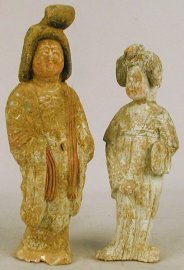
    Similar strength of character and resilience can be seen in Wang Zhaojun, also highly regarded for her beauty during the Han dynasty. Having caught the attention of many at the refined and sophisticated Chinese court, Wang Zhaojun continued to flourish despite having been bargained in marriage to strengthen an alliance with the Huns in the wilderness of the Asiatic steppes.

    Terracotta sculptures that survive from the Han dynasty reflect the tall, slender ideal of feminine beauty so admired by the Emperor. Tomb figures from this period strive to capture the life and vitality of the subject and are noted for their graceful, slender style. Robes worn by noble women during the Han dynasty had a long train that trailed behind, gracefully emphasizing the women's height and stature.

    The Lienuzhuan


    The Lienuzhuan , compiled by the Han Confucian scholar Liu Xiang, contains 125 biographies of exemplary women. Aiming to promote dignity and moral virtue as necessary components of beauty, the Lienuzhuan can be seen as an attempt to caution women against using their beauty to gain power as the sisters Chao Fei-yen and Chao Hede had done. Many stories maintain that external physical beauty is merely a manifestation of internal beauty in the form of virtue. The book contains several biographies of physically ugly women who nevertheless married emperors and became empresses as a result of their attractive, special inner qualities. Women lacking such virtue, on the other hand, are described as scheming to entrap men in sensual pleasures in order to distract them and fulfil their own selfish plans. These women are attributed with causing disruption and breakdown in families and the state. It appears therefore that, whilst not regarded as necessarily dangerous, beauty at this time was strongly linked to female virtue. As such, beauty could be displayed primarily through strength of character and moral disposition.

    T'ang dynasty (AD 618 - 907)


    The T'ang dynasty is renowned for the artistic and personal freedom it afforded women. Artwork from the period shows energetic, full-bodied women engaged in outdoor athletic sporting pursuits such as polo on horseback (2). Delicate features and plump faces in sculptures of aristocratic ladies of the T'ang dynasty convey the ideal image of feminine beauty. Ceramic figures of elegant female courtiers that were used as tomb furnishings in the period are known today as 'Fat Ladies' for their fleshy faces.

    The origin of this standard of beauty can be attributed to the T'ang emperors' preference for plump women as a sign of wealth and privilege. An example of such a woman is Yang Kuei-fei, a heavy and robust concubine with whom the Emperor Ming Huang became infatuated. Known as the 'Jade Beauty', she is celebrated as one of the most beautiful women in Chinese history. Chroniclers at the time described her white skin and delicate features, comparing them to fine carvings in the jade with which she surrounded herself.

    Song dynasty (AD 960 - 1279)


    The Song dynasty was marked by a return to Confucianism and a desire to live a simpler life than in the former T'ang dynasty. Peace and economic security encouraged a flourishing of such educational and intellectual activity. This is reflected in a plainer style of dress for both men and women during this period.

    In contrast to the T'ang dynasty, women were now encouraged to remain indoors and to be seen by none but their husbands. It was socially expected that women should display their virtue physically. This expectation was instrumental in establishing the practice of footbinding during the Song dynasty. The physical limitations of bound feet were intended to emphasize female delicacy and vulnerability in comparison with superior male strength, thereby confirming men's sense of mastery over women. In effect, female subservience to men in Song society was encouraged as a display of the highest form of chastity and virtue. Attention to physical appearance was therefore crucial to women in attracting the interest of both powerful men for marriage, and husbands in competition with their other wives and concubines. Paintings commissioned by emperors during the Song dynasty portray women according to these presiding standards of graceful and plaintive beauty (3).
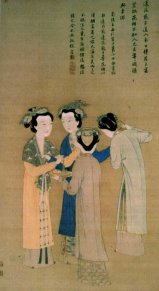
    Ming dynasty (AD 1368 - 1644)


    Between 1279 and 1368, China was under the foreign domination of the Monguls. During this period, the Monguls restricted the assimilation of Chinese culture and attempted to preserve their own national character. Following the success of an uprising against the Mongols in the 1350s, a new Chinese dynasty with the name Ming was declared in 1368. The founder, Zhu Yuanzhang, aimed to restore a traditional Han cultural identity. The growth of urban prosperity and cosmopolitan entertainment can be contrasted with the solitude and reclusion expected of women. They were classed as outsiders as a result of male anxiety and warnings about the dangers of their beauty.

    Footbinding became more widespread and severe during the Ming dynasty as the "symbol for feminine beauty, hierarchy and morality" (4). The author Wang Ping comments on poetry from the period, writing that "The women presented in these poems and literary works all have the same qualities: they are floating and weightless like unreachable treasure. Men cannot help feeling pity for them and falling in love with them" (5). The ideal of beauty portrayed in such poetry emphasizes sickness, fragility and suffering as much as it does delicacy, elegance and grace.
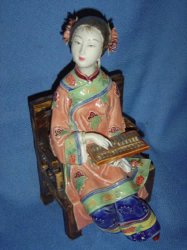
    However, the meaning of bound feet in the Ming dynasty was essentially grounded in eroticism. Bound feet were central to a woman's identity as an aspect of her beauty that she could control. An outpouring of novels, plays and poetry by female writers at this time highlights the erotic associations of bound feet. The 'Three Inch Golden Lotus' standard of perfection in foot length was therefore closely associated with an expression of sexuality. As such, footbinding formed part of a larger valorisation of passion, or qing, that is characteristic of the Ming dynasty. A high point of Chinese erotic culture, the cult of qing helped to bring explicit sensual and passionate significance to ideals of beauty in women.

    Ch'ing dynasty (AD 1644 - 1911)


    The conquest of the Ming dynasty by the Manchus in 1644 brought China under the authority of the Ch ing dynasty. The State attempted to regulate the sexual and gender roles of women through the prohibition of footbinding and the promotion of chastity in widowhood. Although footbinding continued among upper-class women, as the historian Susan Mann writes, "the meaning of bound feet shifted away from eroticism and toward social responsibility" (6). In other words, footbinding became a mark of social elitism and feminine morality rather than a symbol of eroticism as it had been in the Ming dynasty. Indeed, 'beauty' was no longer a formal requirement in ideal standards relating to the role of women during this period. Women were expected to possess virtue and talent, but beauty as a suggestion of passion and sexuality was inhibited.

    The difference between ideals of beauty in the Ming and Ch'ing dynasties is revealed in the exclusion of all poems dealing with love, sex or romance from a collection of women's poetry by Wanyan Yun Zhu, published in 1831 (7). She wrote that, "in compiling this anthology, I have attached the greatest importance to purity of emotional expression and the harmony and elegance of rhymes poems about sexual love and romance by courtesans, whom earlier compilers anthologised profusely and rhapsodised over, are not included here."

    Political, economic and social change (1911 - 1976)


    Underlying currents of nationalist protest against Manchu authority in China fuelled the organization of a Republican movement in the 1890s. In 1911, Sun Yat-sen was elected provisional president of the Republic of China. Following the May 4 th Movement of 1919, nationalist movements involving large sections of the population aimed to push China towards modernization. Increased contact with the West through trade and commerce brought many women in China together with new Western ideas of gender equality and women's rights. Not surprisingly, ideals of feminine beauty were influenced by women's emancipation and pursuit of education, employment and independence. The practice of footbinding declined and many women wore the cheungsam or qipao . In response to the shorter skirts seen in Western fashion, the cheungsam was tight fitting with high side-slits. It revealed more of a woman's body than any previous style of Chinese clothing. 'The Changing Face of Chinese Beauty' (8) details the rise in popularity of lipsticks, eyebrow plucking and shorter fringe lengths during this period, and the way in which women continued these practices surreptitiously during the Cultural Revolution (1966 - 76). These changing aspects of beauty symbolized the transition from more restrictive traditions to women s newfound freedom in China.

    Consumer culture and beauty industries (1976 - 2003)


    The death of Mao Zedong on September 9 th 1976 heralded the end of an era and the beginning of an 'open-door' policy with further economic reforms in China. The first Chinese fashion magazine, Shizuang , or 'Fashion', was published in Peking in 1979. Receptive attitudes and experimentation with regard to Western fashion styles signalled a growing interest in personal appearance, beauty and consumer culture. Within this consumer culture, changing attitudes to women in China can be discerned. Female beauty became a commodity in a renewed importance of the expression of body and gender ideals. Consumerism provided an alternative arena for femininity outside the domination of the Party State.

    However, a dichotomy between nature, tradition and China on the one hand, and culture, modernity and the West on the other hand, can be seen to underlie contemporary Chinese consumer culture. Whilst women in China are advised to make themselves 'modern', sexy and alluring, they are also expected to represent Chinese culture and values through the proper enactment of chastity and submission in their roles as housewives. The tension between these two ideals is expressed in magazine advertisements. For example, whilst advertisements for bust enhancers portray uninhibited women with natural curves symbolizing modernity and Western civilisation, those for skin care products tend to rely on pictures of chaste, shy women wearing traditional Chinese dresses in domestic settings. Similarly, the rising popularity of beauty pageants in China, with the Beauty Queen Guan Qi being crowned Miss China on September 21 st 2003, reveals a conflict between the desire to embrace a Western tolerance towards activities once suppressed as being bourgeois and decadent, and the need to justify the competitions in terms of providing suitable role models for women. An emphasis on the judgement of beauty in manners and education as well as in appearance is reminiscent of the traditional Chinese ideals of inner virtue and talent in women regarded as beautiful.

    Furthermore, the export of American entertainment products such as films, music and MTV, together with the aim of opening markets for Western beauty products and technologies in China are reflected in the rapidly changing norms of attractiveness among Chinese women in recent years. As a result, the processes of globalization are implicated also in the establishment of beauty industries in China. Practices promoted by these industries typically include breast enlargements, skin whitening procedures, limb lengthening and the creation of 'double' eyelids. Cosmetic surgery is becoming increasingly popular as a means of altering the shape of noses and eyes to accord with Western appearances (9). Ideals of beauty in contemporary Chinese culture can therefore be seen to be attached to symbolic meanings based on China's transformation from a closed socialist society to a globalized consumer culture.

    Sources:
    (1) In The Machinations of the Warring States , a 33 volume work by Liu Xiang ( c 77-6 BC) of the Former Han period.
    (2) For example, the Tri-color Glaze Pottery Figure of a Lady playing Polo in the permanent collection of the National Palace Museum, Taipei.
    (3) For example, Looking in a Mirror by an Ornamental Box by an anonymous Song painter in the permanent collection of the National Palace Museum, Taipei.
    (4) Ping, W. (2000) Aching for beauty: Footbinding in China , Minneapolis, University of Minnesota Press.
    (5) Ping, W. Ibid.
    (6) Mann, S. (1997) Precious Records: Women in China's Long Eighteenth Century , Stanford, Stanford University Press.
    (7) Wanyan Yun Zhu (1831) Correct Beginnings: Women's Poetry of our August Dynasty (Guochao quixiu zhengshi ji).
    (8) http://www.chinavista.com/experience/old/beauty.html
    (9) BBC News, Chinese woman seeks perfect beauty , published 2003/07/24

    Article Source:
  • beautymatters blog


  • Terra Cotta Warriors


    The Terra Cotta Warriors and Horses are the most significant archeological excavations of the 20th century. Work is ongoing at this site, which is around 1.5 kilometers east of Emperor Qin Shi Huang's Mausoleum, Lintong County, Shaanxi province. It is a sight not to be missed by any visitor to China.

    Terracotta Warriors in XianUpon ascending the throne at the age of 13 (in 246 BC), Qin Shi Huang, later the first Emperor of all China, had work begun on his mausoleum. It took 11 years to finish. It is speculated that many buried treasures and sacrificial objects had accompanied the emperor in his after life. A group of peasants uncovered some pottery while digging for a well nearby the royal tomb in 1974. It caught the attention of archeologists immediately. They came to Xi'an in droves to study and to extend the digs. They had established beyond doubt that these artifacts were associated with the Qin Dynasty (211 --206 BC).

  • Map of Terracotta Warriors


  • Terracotta Warriors in XianThe State Council authorized to build a museum on site in 1975. When completed, people from far and near came to visit. Xian and the Museum of Qin Terra Cotta Warriors and Horses have become landmarks on all travelers' itinerary.

    Life size terracotta figures of warriors and horses arranged in battle formations are the star features at the museum. They are replicas of what the imperial guard should look like in those days of pomp and vigor.

    Terracotta Warriors in XianThe museum covers an area of 16,300 square meters, divided into three sections: No. 1 Pit, No. 2 Pit, and No. 3 Pit respectively. They were tagged in the order of their discoveries. No. 1 Pit is the largest, first opened to the public on China's National Day, 1979. There are columns of soldiers at the front, followed by war chariots at the back.

    No. 2 Pit, found in 1976, is 20 meters northeast of No. 1 Pit. It contained over a thousand warriors and 90 chariots of wood. Terracotta Warriors in XianIt was unveiled to the public in 1994. Archeologists came upon No. 3 Pit also in 1976, 25 meters northwest of No. 1 Pit. It looked like to be the command center of the armed forces. It went on display in 1989, with 68 warriors, a war chariot and four horses.

    Altogether over 7,000 pottery soldiers, horses, chariots, and even weapons have been unearthed from these pits. Most of them have been restored to their former grandeur.

    Terracotta Warriors in XianThe Terracotta Warriors and Horses is a sensational archeological find of all times. It has put Xian on the map for tourists. It was listed by UNESCO in 1987 as one of the world cultural heritages.

    Article Source:
  • chinadiscover.net

  • Click here for the Wiki Article


  • History - Chinese Foot Binding


    Click here to see a picture of a Chinese Bound Foot (explicit content warning!)
    Throughout history women have had to endure horrible things to be deemed beautiful. The ancient tradition of foot binding in China, however, takes the "beauty is pain" concept to a whole new level.

    The Origins of Foot Binding - The Golden Lotus

    In the early 10th century, emperor Li Yu of the Southern Tang dynasty in China ordered one of his slave girls to bind her feet in silk ribbons and dance on a platform littered with golden lotus flowers. From that day on, foot binding was often associated with the term golden lotus. At first, foot binding was something practiced only by those within the royal court but soon women of all social classes were eager to have dainty, "beautiful" and desirable feet.

    How Were Feet Bound?

    So exactly what did foot binding do to the feet? Well, young girls would have their feet bound for the first time when they were about five years old. Their mothers would take long lengths of cloth and bind the feet so that the toes would bend under and the bones in the foot would break, forcing the front and back of the foot together, giving the appearance
    Click here to see a picture of a normal foot compared to a Chinese Bound Foot
    of a high arch and tiny foot. The ultimate foot was to be between three and four inches (about 10 cm) long. Over the course of about three years, a girl's foot would be broken numerous times to get it to the perfect shape.

    Foot Binding Facts

  • Since foot binding made it virtually impossible for women to get around on their own, many peasant women did not bind their feet. They had to work in the rice fields, and later the tea factories, so they had to be able to use their feet.
  • Foot binding was seen as a sign of beauty and attractiveness. Once a girl was of marriageable age, prospective mother-in-laws would come around and pick a wife for her son by the appearance of the girl's feet.
  • Bound feet were thought to be so alluring because they were always hidden. Bound feet were covered in bindings, socks and shoes and then doused in perfume and scented powder. They were then hidden under layers of leggings and skirts.

    Article Source:
  • kidzworld.com

  • Click here for the Wiki Article


  • China to hold fake beauty pageant


    Miss China, Qi Guan, who came third in Miss World 2003
    Natural beauties like Miss China Qi Guan will not be eligible


    Plastic surgeons around the world are being given the chance to show off their talents, in a new artificial beauty pageant in China.

    A contest will be held in October among women who have undergone cosmetic surgery, according to state media.

    It will be open to any woman who can prove her beauty is man-made.

    Plastic surgery is on the increase in China, China Daily newspaper said, with around 20bn yuan ($2.4bn) spent yearly on beauty treatments.

    The idea for "Miss Plastic Surgery" was reportedly born after a woman was barred from a traditional beauty contest after spending $13,000 on 11 cosmetic operations.

    The paper said China now had a million beauty salons, employing six million people.

    Their clients range from body-conscious teenage girls to women in their 30s seeking facial jobs and breast implants, it added.

    The rise of the salons is based on the assumption that beauty is a route to success, China Daily said, citing findings by US economists which indicated that good looks increased overall hourly income by 5%.

    China recently lifted a 54-year ban on beauty pageants, which the authorities used to see as bourgeois and decadent.

    But the explosion of economic growth and the loosening of social controls of the past few years has led to a growing preoccupation with how people look.

    The Miss World contest was held in China for the first time in 2003.

    Article Source:
  • news.bbc.co.uk


  • There's so much competition among the chinese (and other people) that they even spend $$ to just get that lil advantage when being on a job hunt. Now people when do you realise that if you all would get plastic surgery, that you ALL look the SAME!
    For all you know next decennia beauty might mean having NO double eyelids at all! So remember every person is special in his/her own way, so PLEASE let us keep it that way! Better spend the money on proper education than on fashion. Because educated people know better! ;-) Remember Caesar once said: "Divide et Impera" (divide and conquer) and that my friend is what marketing is about... Making you feel bad, so they can sell stuff to you! So next time you spend $$ think about it if you REALLY need it or just REALLY want it.

    If you have read all the above, but even if you aren't "strong" enough to follow the above rule of thinking, atleast you educated yourself some more! :D